

You’ve hired a tutor. Your child is spending extra time practicing. Maybe you’re even seeing more completed homework and better test preparation. So why aren’t the grades improving?
Sometimes, the problem isn’t that a student needs more tutoring. It’s that traditional tutoring isn’t addressing the specific, foundational skills getting in the way of real progress.
Six Reasons Your Child’s Academic Progress Might Be Stalled
#1: Grades measure performance, not underlying skills.
A grade tells you how a student is performing on a specific assignment, not why they’re struggling. A student struggling with reading comprehension may actually have difficulty decoding words accurately or fluently. A student struggling in algebra may have foundational math gaps that make advanced concepts nearly impossible to grasp. Improving performance starts with identifying and strengthening those underlying skills. (For more information on this, check out Beyond Report Cards: How to Really Know if Your Child is Learning.)
#2: Accuracy isn’t the same as fluency.

Getting an answer right is a great first step, but what happens when a student has to do it independently and efficiently under pressure? A skill that is accurate but slow requires massive effort. Fluency means performing a skill accurately, efficiently, and automatically. When foundational skills become fluent, students free up the mental capacity needed for higher-level problem-solving, comprehension, and writing.
Want to learn more about why speed and effortless recall matter just as much as getting the right answer? Read our post on The Science of Fluency.
#3: Homework help isn’t foundational remediation.
Traditional tutoring often focuses on short-term fixes: tonight’s homework, tomorrow’s quiz, or a concept missed in class this week. While helpful in the moment, it doesn’t solve deeper issues. If a student has a foundational skill gap, helping with current assignments merely works around the problem. Targeted remediation fixes the foundation so the student can become independent over time.
#4: Finding the gap requires precise measurement, not guessing.
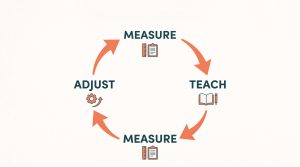
When a student struggles, the default response is often to offer more explanations, more hand-holding, and more hours at the desk. But continually compensating for a missing skill won’t build long-term confidence. Reaching a breakthrough requires pinpointing exact skill breakdowns through objective measurement — tracking whether a skill is actually improving, not just whether homework was finished.
This is the core of Fit Learning’s individualized, data-driven approach: Measure → Teach → Measure → Adjust. By evaluating performance continuously, instruction dynamically adapts to your child’s exact needs in real time.
#5: Without measurable progress, it’s hard to know what’s working.
A student may feel more confident, and a tutor may feel lessons are going well … but feelings aren’t data. At Fit Learning, our coaches continuously measure student performance during every session. This objective data dictates what to teach next, when to increase the challenge, and when a skill has genuinely reached mastery.

#6: More hours don’t guarantee better results.
Simply adding more tutoring hours rarely solves a stalled grade. Instead, ask these crucial questions:
- Is the instruction targeting the root-cause skills?
- Is the student becoming truly fluent?
- Is the student mastering new skills, or just practicing old habits?
- Is progress being measured frequently enough to know if the approach works?
The total hours matter far less than what actually happens during those hours. In other words, the goal isn’t simply to spend more time tutoring — it’s to make the time count.
Looking Beyond Standard Tutoring
If your child’s grades aren’t improving despite extra help, it’s time to shift focus. Ask yourself: What specific skills are holding my child back, and how are we tracking their improvement?
The goal isn’t just to give a student more help. Rather, it’s to help them become a capable, confident, and independent learner.
Ready to find out what’s really stalling your child’s progress? A Fit Learning Assessment identifies specific skill gaps and provides objective data showing where your child is starting and how they’re progressing. Contact us today to get started.