

Fit Learning’s Supplemental Literacy Services target the foundational handwriting and spelling skills that underpin confident, fluent written communication — because when the basics are automatic, everything else gets easier.

Foundational Literacy Support for Handwriting and Spelling
Some students struggle with the foundational mechanics of written language long before higher-level composition becomes the primary challenge. Fit Learning St. Louis offers supplemental literacy services — the Fit Penmanship and Fit Spelling programs — that strengthen handwriting fluency, spelling accuracy, written output, and other foundational skills that support successful reading and writing development.
Note that these programs differ from Fit Expressive Writing, which focuses on grammar, composition, sentence construction, and written communication. Supplemental literacy services target the underlying transcription and encoding skills that help students write more efficiently and confidently.
Fit Penmanship: Handwriting and Written Output Fluency
As learning experts, we understand how hard it is to watch your child struggle. Unfortunately, when a child has trouble with penmanship and writing letters and numbers, they struggle in a multitude of other academic areas. This can affect their overall confidence in school and cause them to doubt their ability as a learner.

But, your child does not have to struggle with penmanship. Fit Learning St. Louis has learning coaches ready to help your child learn penmanship skills in a fun way that is backed by science and research. Fit Learning’s penmanship program helps students develop clear, confident handwriting by building the fine motor skills, letter formation, and consistency needed to put their ideas on paper — and keep up in the classroom. When you enroll your child in Fit Penmanship, you will be amazed at their penmanship improvement and their overall confidence will grow.
Who Benefits From Fit Penmanship?
- Students who have good ideas but struggle to put them on paper
- Children whose school team shifted away from handwriting goals before they developed functional written output skills
- Learners who you, as a parent, feel that with the right instruction can learn to write letters and numbers correctly on paper
- Students who have made handwriting progress with an occupational therapist, but the intervention did not produce the results you expected
What Is Covered in Fit’s Penmanship Curriculum?
While each learner’s journey is unique, some of the broad skill areas covered in Fit’s penmanship curriculum include the following.
- Fine motor (touch, squeeze, tap, lace, grasp)
- Basic strokes (lines, circles, loops)
- Writing alphabet (upper and lowercase)
- Writing digits
- Form and size
- Copying text
How Fit Penmanship Differs From Traditional Occupational Therapy (OT) Services
An occupational therapist, or OT, would likely teach your child similar penmanship skills. However, while occupational therapy often focuses on underlying motor development, Fit Penmanship emphasizes fluency, repeated practice, and measurable written output performance within academic tasks.
Fit Spelling: Spelling and Encoding Skills
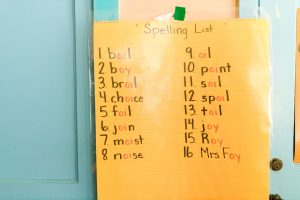
Increasingly these days, spelling is not being taught in schools. Oftentimes, parents are assigned to “teach” their learners “how to spell” using spelling lists, followed by weekly classroom tests. Students aren’t given explicit instruction on the rules to apply when spelling, making the information particularly tough for them to learn and retain. Even in an era of “spell check” functionality, it’s important that learners have a good grasp of spelling-related concepts and rules. Because not only is spelling a key component of overall effective communication, but it also goes hand in hand with students’ ability to read and write fluently, as described here and here.
 The good news is, regardless of how well your learner can (or can’t) spell currently, Fit can help take their learning to the next level. Fit Spelling helps learners of all ages and abilities in grades 2-12. Before their instruction begins, Fit students take a comprehensive skills assessment, which identifies the “gaps,” or the building block concepts he or she just didn’t fully understand when they were first taught. The results of the intake assessment will determine exactly where the Fit learning coach begins in the 1:1, customized learning sessions. Once the learner has fully mastered the basic building block skills, they move on to learn higher-level spelling skills. And, as with other Fit programs, each student advances through the Fit Spelling curriculum at their own pace. At the end of the enrollment, learners are competent – and confident – spellers. In fact, we consistently see learners achieve 1-2 year’s academic growth in as little as 40 hours of instruction.
Note that students needing support with grammar, sentence structure, and composition may also benefit from our Fit Expressive Writing program.
Who Benefits From Fit Spelling?
- Students who struggle to learn how to spell correctly or who find spelling particularly frustrating and an obstacle to their expressive writing
- Learners who can usually pass classroom spelling tests, but don’t seem to be able to retain and retrieve the information afterward
- Children who have been diagnosed with dyslexia, ADHD, dysgraphia, dyspraxia, learning disabilities (LD), learning differences, or any other condition that makes learning spelling especially challenging
- Students who you, as a parent, feel could improve their writing (or reading) abilities with an even better grasp of spelling and grammar
What is Covered in Fit Spelling’s Curriculum?
While each learner’s journey is unique, some of the broad skill areas covered in Fit’s spelling curriculum include the following.
- Phonemic awareness, or learning how words sound in spoken language and blending distinct sounds into words
- Orthography, or understanding letter patterns/sequences and being able to apply spelling rules
- Morphologic awareness, or grasping the smallest units of meaning within words, prefixes and suffixes, and compound words
- Sight words, or instantly recognizing (and spelling) commonly used words
- Word families, or spotting patterns, root words, and common meanings or sounds
What Makes Fit Learning Different?

Unlike other tutoring programs, Fit addresses the cause of the issue, not the symptoms. Our precision teaching method doesn’t focus on the concepts your child’s teacher is going over right this moment. After all, the difficulty they are having right now is a symptom. Instead, through our assessment process, we find the source of your child’s struggles and we treat that source. This paves the way for future learning success, above and beyond just getting through what is currently being covered in class.
Here are some other important ways that Fit differs from traditional tutoring.
- Evidence-based: Our curriculum is backed in science and research.
- Systematic: Students practice basic skills until they master them, and then move on to more complex skills.
- Focused on fluency: Your child will work on certain skills until they become effortless.
- Individualized: We provide 1:1 instruction to every child.
- Taught explicitly: Sessions are goal-driven and have lots of opportunities to practice the right answer.
- Fast paced: Coaches hold kids’ attention by moving quickly, so there’s no time to be bored.
- Rich in frequent feedback: Our learning coaches resemble sports coaches and motivate your child through praise (and prizes!).
- Multi-sensory: Fit learners practice by seeing, hearing, doing, moving, and writing.
- Fun! Learning coaches provide lots of positive reinforcement, and they reward effort and personal bests.
How Foundational Literacy Skills Support Academic Success
Strong foundational literacy skills help students participate more confidently and efficiently across nearly every academic subject. When handwriting, spelling, and written output become more fluent and automatic, students can devote more attention to higher-level thinking, comprehension, and communication. Students who struggle with foundational writing mechanics often expend significant mental effort on tasks such as forming letters, recalling spelling patterns, or organizing written output. As a result, classroom assignments may feel slow, frustrating, or overwhelming — even when the student understands the material being taught.
Improving foundational literacy fluency can support:
- Faster note-taking
- Improved writing stamina
- Greater spelling automaticity
- Reduced writing frustration
- Increased classroom confidence
At Fit Learning St. Louis, supplemental literacy services focus on building fluency and automaticity in the underlying skills that support successful written communication. These foundational skills often complement broader academic programs such as reading intervention, expressive writing, and executive functioning support.
Get Your Learner Started With Supplemental Literacy Services
Handwriting and spelling difficulties can affect far more than written assignments alone. When foundational literacy skills become more fluent and automatic, students often experience greater confidence, stronger classroom participation, and less frustration during academic tasks. At Fit Learning St. Louis, our individualized supplemental literacy services help students strengthen the foundational skills that support successful reading and writing development.
To get started:
- Contact Fit Learning St. Louis to discuss your learner’s needs.
- Schedule a comprehensive intake assessment.
- Begin individualized instruction designed to build fluency, confidence, and academic independence.